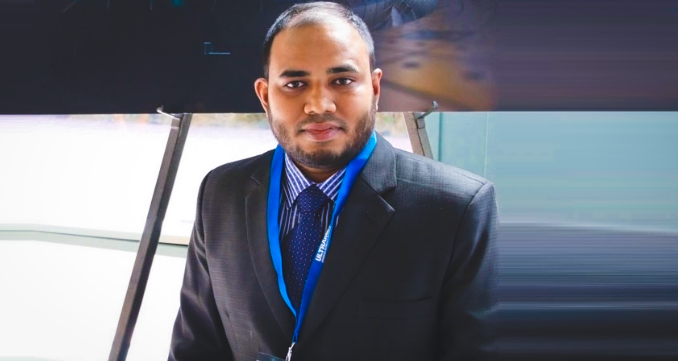
Dhaka, Oct 10 (bdeconomy) — Dr M Khalid Hossain, Senior Scientific Officer at the Institute of Electronics under the Bangladesh Atomic Energy Commission (BAEC), has been named among the world’s top 2 percent of scientists for the fourth consecutive year.
Stanford University and research publisher Elsevier jointly published the prestigious global list for 2026 on October 8. The ranking evaluates researchers worldwide across 20 scientific fields and 174 sub-fields based on Scopus-indexed research publications, categorizing them by career-long impact and single-year research impact.
Dr Hossain secured a place in both categories on the 2026 list. In the career-long impact category, he ranked 55th among 105 Bangladeshi researchers included so far. Meanwhile, in the single-year impact category, he secured the fifth position nationally among 347 Bangladeshi scientists.
Reflecting on his recurring global recognition, Dr Hossain shared that his decision to return to Bangladesh after completing higher studies in Japan was rooted in a commitment to advance domestic scientific research.
“It is my duty to contribute to scientific research in my country by using my knowledge and experience. That is why I returned to Bangladesh instead of taking a job or remaining in Japan after completing my degree. I believe I have been able to give something back to my country, even if only to some extent, and I consider this a major achievement for me,” he said.
Dr Hossain earned his BSc and MSc degrees with first-class honors from the Department of Applied Physics, Electronics and Communication Engineering (currently Electrical and Electronic Engineering) at Islamic University. He joined BAEC as a scientific officer in 2012. In 2021, he completed his PhD in Nuclear Energy Materials from Kyushu University in Japan under the Japanese government’s MEXT Scholarship program.
A prolific researcher, Dr Hossain has authored 11 scientific books and published over 350 peer-reviewed articles in internationally recognized journals. His scholarly work has garnered more than 20,000 citations, with a reported h-index of 75. His core research interests span nuclear energy materials, solar cells, fuel cells, nanomaterials, ceramics, hydrogen energy materials, electrochemical devices, and proton-conducting oxides.